Diary Excerpts as Titles: When the Internal Landscape Frames the External
Since 2008, I've titled my paintings with excerpts pulled straight from my personal diaries. They're the words I wrote on ordinary days — whatever I was thinking or feeling around the time the work was being made. I don't compose them afterwards to fit the work. Instead, I just reread my journals and pull out phrases already in the writing, then play a game of mix-and-match to see what happens when I attach them to a specific painting.
"It's both helpful to know what it likely is, and also a period of grieving, as I honestly never expected it to be this way."
"I'm nervous about the procedures next week."
Neither of these describes a painting. The first isn't about an island at dusk. The second isn't about clouds. They're about what was happening inside me while I worked — diagnosis, medical procedures, the tangle of feelings that arrive together when you're living with chronic illness.
How it started
The practice began almost by accident. I'd kept diaries since I was a little girl, writing most days with no plan to use them for anything — they were just where I sorted things out, made sense of the world and my own interior experience of emotions, interactions, planning and reflection. At some point, I noticed the paintings were coming from that same place. Both were ways of paying attention, of turning something interior into something I could see. The diary used words. The paintings used colour, light and atmosphere.
Using the diary excerpts as titles felt like a natural progression; I liked admitting that the two were connected. The painting was never separate from my life. It was happening inside my life, shaped by everything else I was carrying.
Holding both at once
When a viewer stands in front of a luminous study of cloud dissolving into blue and the title reads "I'm nervous about the procedures next week," the painting stops being purely about a pleasant sunset. A private fear is now set against all that calm, open light, and the two don't resolve into one tidy meaning.
The title asks you to hold the landscape and the interior weather side by side, each one informing the other.
Some people find that uncomfortable. They'd rather the painting stay safely about landscape and leave the messy human part out of it. Others tell me it makes the work feel more honest — like being shown the conditions the art was made under, the whole untidy reality of it.
The risk, and why I take it
There's a form of real exposure in this. Putting words about grief or medical fear into public space, attached to work that curators and collectors will see, can feel very vulnerable, of course.
The convention says keep the personal and the professional apart. Let the work speak for itself. Hold the mystique — the suggestion that paintings arrive from some elevated place untouched by ordinary struggle. But that has never been true for anyone. Every painting is made by a particular person living a particular life on a particular day. We just tend to hide it.
The diary excerpts refuse that hiding. They say plainly: this was made by someone navigating chronic illness and uncertainty and a body that doesn't behave predictably. To me, that makes the work more approachable in some ways. More relatable, even — it acknowledges the unpleasant, the messy middles, the emotional upheavals, the grittiness of the human condition, through sharing the personal.
Specificity is the bridge
There's an old belief that art should stay universal — that the more personal you get, the fewer people you reach, so better to keep things vague and open.
I've found the reverse. The more exact I am about what I was living through, the more people tell me the work speaks to them, and might even meet them in what they're experiencing themselves. They haven't lived my exact circumstances. The shape underneath is familiar, though — waiting on results, sitting in uncertainty, feeling contradictory things at once, living in a state that won't resolve.
When I title a painting "It's both helpful to know what it likely is, and also a period of grieving, as I honestly never expected it to be this way," I'm being very specific about the day I learned something I couldn't unlearn. I'm leaving some details out, so the phrase becomes an opening — somewhere others can bring their own experiences, and their expertise in their own lives, and lay all of it across the painting. At best, it helps someone feel a form of connection: with themselves, or with the knowledge that they aren't alone.
I like the gap the titles open between the work and the viewer's experience of it — a space where someone can overlay their own grief or wonder or lived experience, within their own circumstances, and notice that when we stand in front of a landscape or the ocean, we're each also having a private interior experience. We carry an internal monologue that was never divorced from the world we're looking at or immersed within.
What the titles don't do
They don't explain the paintings or tell you how to feel. They don't turn the landscape into a symbol for my life. The island at dusk is still an island at dusk — a place, with light and dark, observed and translated into paint. The diary line simply adds another layer: here's what the painter was carrying in the same season of her life.
Neither cancels the other out. The landscape exists on its own terms. My experience of it was present too, and it can be acknolwedged in a way that makes the human experience of place more universal.
Why I keep going
Seventeen years in, I've no intention of stopping. The titles root each painting in real time. And they hold a quiet position I care about: that grief, challenges and uncertainty aren't shameful things to tuck away. They're part of being human, and they shape what we make, whether we name them or not. I'd rather name them.
I feel very honoured that the painting, which took Overall Winner at Critical Mass exhibition held at Umbrella Studios in 2026, carried a diary title from my personal life — about knowing and grieving in the same breath, about things not turning out as expected. The jury saw the painting, read the title, and chose it as it spoke to them, too. The island sits in that liminal light. The words name what I was holding while I painted it. Both are part of the work.
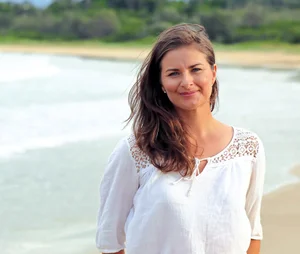
Nicola Newman is a contemporary Australian artist working in oil on canvas. Her atmospheric coastal landscapes have been exhibited nationally, and she paints from her studio in regional North Queensland. Since 2008, her paintings have carried titles drawn from her personal diaries.